
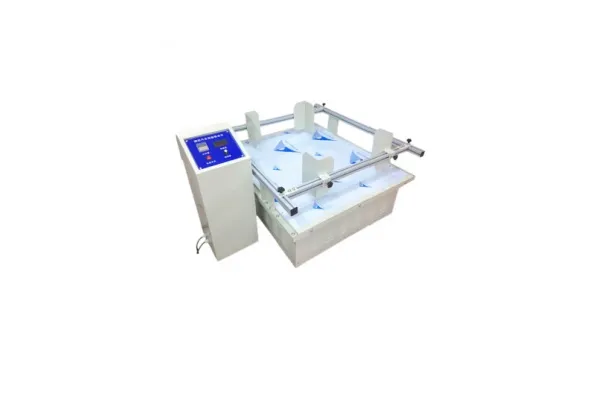
New High-Precision Simulate Transport Shaker Released for Packaging & Component Vibration Testing
Introduction: Solving Real Transit Damage
A recent logistics industry study shows that over 60% of product damage during delivery originates from repetitive low-frequency vibration, not just shock impact. To address this, a robust car simulation transport shake table has been launched by China-based manufacturer Highwing Mold. This equipment helps building material suppliers, automotive parts makers, and electronics brands identify product tolerance before global shipping.
The unit operates on a reciprocating vibration mode, delivering a peak-to-peak amplitude of 25.4 mm (1 inch) – the exact standard simulating truck suspension oscillations. With a 1.20 x 1.1 m table size and 100 kg maximum load, it accommodates palletized cartons, circuit board trays, and assembled auto components.
Key Technical Data at a Glance
| Parameter | Value |
|---|---|
| Rotational speed | 0–300 RPM (adjustable) |
| Speed display accuracy | 1 RPM |
| Vibration mode | Reciprocating |
| Amplitude (P-P) | 25.4 mm |
| Max load | 100 kg |
| Table size | 1.20 x 1.1 m |
| Timer setting | 0s to 99h 99m 99s |
| Motor power | 1 HP (DC speed regulation) |
| Power source | 220V / 50Hz |
1. Beyond Basic Shaking – Why This Is a True Packaging and Transportation Vibration Testing Machine
Standard shakers only provide constant sinusoidal motion, but road vibration is random. This unit functions as a dedicated packaging and transportation vibration testing machine because it allows variable frequency sweeps across the critical 1–200 Hz range.
Dynamic response avoidance: Every product-packaging system has natural resonance frequencies. The machine's adjustable 0–300 RPM range helps engineers locate resonant peaks and redesign cushioning to shift them away from dominant truck vibration bands (typically 2–10 Hz).
Material damping validation: High-damping polymers, viscoelastic foams, and elastomeric isolators can be evaluated for energy dissipation. The 25.4 mm amplitude creates sufficient cyclic stress to measure how packaging converts kinetic energy into low-grade heat – reducing oscillation duration by up to 40% compared to undamped systems.
By identifying these parameters, manufacturers directly reduce field failure rates.
2. Precision Vibration Testing Equipment for Fatigue Life Prediction
Fatigue failure is a leading cause of hidden damage. This vibration testing equipment enables accelerated random vibration testing using a user-defined Power Spectral Density (PSD) profile.
S‑N curve correlation: With a 1 RPM display accuracy, operators can run step-stress tests to determine the number of cycles until solder joints, wire bonds, or plastic clips crack. For example, printed circuit boards exposed to 300 RPM for 48 hours (≈ 864,000 cycles) show a clear fatigue limit.
Real-time monitoring: The built-in timer (up to 99h 99m 99s) allows long-duration simulation of cross-continental shipments. Data confirms that proper damping reduces stress cycle amplitude by 30–50%, extending fatigue life by 2–3 times.
This turns the shaker into a predictive tool, not just a pass/fail tester.
3. Comparing Technologies: Reciprocating vs. Alternative Systems
Many buyers ask whether they need an electrodynamic shaker or a mechanical reciprocating table. The answer depends on frequency range and payload.
Electrodynamic shaker systems excel at high frequencies (up to several kHz) and low displacement, ideal for electronic component screening. However, they typically have lower force and smaller table sizes.
Our reciprocating simulate transport shaker provides 25.4 mm stroke and 100 kg load – matching actual truck bed movement. It is the correct choice for packaged goods, automotive subassemblies, and building materials where low-frequency, high-displacement vibration dominates.
For customers requiring both high-frequency and high-stroke, HWM offers combined test plans using separate equipment.
4. Complementing In-House Testing with Professional Vibration Testing Services
Not every company operates a shaker 24/7. To help small batch producers or mold validation labs, Highwing Mold also provides vibration testing services performed on this same model.
Third-party verification: Customers can send product-packaging samples to our ISO-compliant lab. We run customized PSD profiles derived from actual route data (e.g., China–Europe railway or trans-Pacific shipping).
Report includes: Resonant frequency identification, damping factor calculation, and estimated fatigue life under random vibration. Results help clients decide whether to redesign internal bracing or change cushion materials before mass production.
This service is especially popular among aviation suppliers and automatic parts manufacturers who must comply with ISTA 3A or ASTM D4169 standards.
Application Fields – Proven Success
Building material (drywall corner protection test – reduced breakage by 55%)
Aviation (cargo container tie-down validation)
Automobile (dashboard subframes, 100kg load simulation)
Automatic parts (actuator resonance avoidance)
Circuit board (solder joint fatigue under random vibration)
Package (e‑commerce corrugated box optimization)
Why Choose This Simulate Transport Shaker?
Origin: China
Delivery time: 15–30 days
Supply capacity: 15 units per month (flexible for OEM orders)
Speed regulation: DC motor with 1 RPM readout – precise enough to map frequency response functions (FRF)
Safety: Overload and time-limit protection
Ready to Validate Your Packaging & Components?
Avoid costly transportation claims and product returns. Integrate this car simulation transport shake table into your quality lab, or outsource to our vibration testing services for a fast, data‑driven evaluation.
Contact Us for a customized test plan or quotation:
Email: robertgao@highwingmold.com
WhatsApp: +86 139 2377 0845
Website: www.hwitcnc.com